|
To purchase this book, go to Amazon.com or click here.
Excerpt:
Introduction
"I do not seek to follow in the footsteps of the men of old. I seek what they sought." Basho
In early July of 1968, out on a canyon property in the high desert east of Los Angeles, twenty-six men and women set out for five days on an audacious experiment in personal growth and self-awakening. They used the ancient meditation practice of contemplating a question such as "Who am I?" or "What is my true nature?" and combined it with the more modern approach of sitting with a partner and communicating what occurs as a result. The aim was not merely to have interesting experiences or to come up with new intellectual answers to these questions; it was to try to break through into enlightenment, the spontaneous awakening of consciousness known in Zen as kensho or satori. They were going after the real thing, whatever that was. And in this break-the-mold synthesis of East and West, some of them actually succeeded. Their experiment was the birth of what is now known in over twenty countries as the Enlightenment Intensive.
One of the people who succeeded in that first experiment was a thirty-five-year-old Brooklyn man named Yon Kane. Years later, in 1995, Yon sat comfortably by a warm fire in his home in Richmond, California, and described what occurred for him during that time out in the desert:
What happened for me on that first one is that the passion for the truth turned on in me. I was working hard on the question "What is the purpose of life?" I remember lying awake in the middle of the night thinking, "What is it? What is it?!" I was really focused. I was like on a train and all this stuff was going by the windows: thoughts, feelings, images, whatever. But I knew none of that was it. Meanwhile I had this passion for the truth that had just grabbed me, that was driving this train.
The day before, I had gone through a period of real despair, feeling like I had to find more meaning to life than just working at a job and eating. Later I got to another place where I felt that if I asked myself that question one more time I would just die. But I really wanted the truth, so I kept going. Then on the last morning we were doing a sitting contemplation. And suddenly everything disappeared and I went into union. I was in this infinite, timeless experience of union, and it was like no experience I had ever had before. And it no longer mattered what the purpose of life was because the purpose was the union itself that I was experiencing, not some answer.
I was in exquisite ecstasy from this. I would use the word "bliss" now, but I didn't know that word then. For hours, though, every time I touched onto this experience, there were waves of bliss, just waves of it. It was so exquisite, and so unexpected, that I was crying. Later I was laughing from the joy of it all. This continued on throughout the last day.
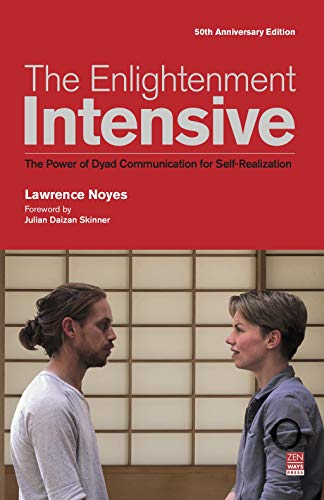
This is a book about the Enlightenment Intensive, a unique method for transcending the morass of the intellect and directly experiencing into the ultimate reality. In its first three decades, over fifty thousand people took one or more of these Intensives. Not all of them got the kind of result that Yon did. Genuine enlightenment is not something that can be guaranteed. Many of these people, though, after three days of working at their question, went home more in touch with themselves and better able to relate authentically with others. Having drunk deeply of the tonic that is the simple spoken truth, a lot of them experienced a freeing up of new energies for living life on a more real and satisfying basis. Many experienced levels of inner peace and stillness of mind that they had never known. And for some, often around a third of any given group, something even more extraordinary took place: the striking breakthrough into enlightenment.
Enlightenment
Enlightenment has been spoken about and written about for a very long time by mystics, religious founders, yogis, Zen masters, and more or less ordinary people who have happened to stumble onto it in the course of their journey through life. Whether in ancient times or modern, there is a consistency in their reports of the special and indescribable nature of the event, the priceless penetrations into reality, the abiding inner peace that remained to some degree afterwards.
Yet in mainstream culture here in the West, there has long been a taboo against serious discussion of what the word 'enlightenment' is really trying to describe. Not many systems have been developed here for coming to experience it. This situation has been changing in recent decades, and the Enlightenment Intensive has been part of that change, but the word 'enlightenment' is still used casually in our language. To this day it can refer to anything from a lecture that someone liked ("It was an enlightening experience") to a rude awakening ("My tax accountant just enlightened me about what I owe this year").
The enlightenment discussed in this book is a unique condition of direct, conscious experience that reveals in an instant of penetration our ultimate nature. This experience goes completely beyond our personality, our body, our problems, and our ideas about ourselves. It is a transformative union of self and truth that is not an insight or even an intuition. Its nature lies outside the realm of our thinking and sensing processes. Yet it is real. And it is the condition that evolves consciousness at the core, revealing the inner splendor of the true self in ways that must be seen and experienced to be appreciated.
On a practical basis, enlightenment has enormous implications for our capacity to achieve a genuine sense of well-being, to face situations on more real terms, to live more from who we really are rather than from our neuroses and upsets. It enables us to conduct spiritual growth in the realm of reality as opposed to the realm of ideas. In many Yogic and Buddhist systems, in fact, the initial awakenings into the realm of enlightenment are even considered the beginning of real spiritual practice. Enlightenment may not necessarily teach us how to balance a checkbook or fix a broken bone, but it does clarify what's what at increasingly more basic levels of existence and nonexistence. This opens doors in our consciousness and in our hearts that mere book-learning or sophisticated thinking processes seem wholly unable to open.
About the long-term effects of his enlightenment experience twenty-seven years earlier, Yon told me:
That experience was my first true spiritual awakening. It changed my whole life. The main thing I got from it was a self-confidence about who I am. I became confident at just being who I am, at being able to hold my own with anybody. It gave me a depth to my life that, as far as I can tell, can't be obtained through any other kind of experience. I've had a real appreciation for people since then, too. Even if they don't think they're someone, I do. I still have things happen in my life, and issues come up, but there is a basic happiness I've had since then that never went away. And I know I'm not totally enlightened. I know this happiness could be deeper. But it's deep enough for me now, and it's totally satisfying. I don't have any anxiety about getting more deeply enlightened, either. If I do, okay, and if there are setbacks, okay. I have this basic knowledge of who I am and the nature of life, so there is no anxiety about all that.
Partner-Assisted Meditation
Up until fairly recent times, most time-tested approaches we've had for enlightenment originated in the East, and most have involved a silent, solo meditation approach of one sort or another. On an Enlightenment Intensive, people also contemplate, and are taught how to do so. The difference is that they have a partner sitting there who will listen to whatever they have to say about what has occurred in their contemplation. This is something completely new. As people alternate five-minute turns in the role of the listener, both are more able to journey ahead in their own unique process of self-discovery.
In these dyads, people face all the tricks and demons of the mind that solo meditators throughout history have come to know. These tricks and demons all take place: mind chatter, drowsiness, boredom, doubts, and fears, along with the more pleasant, nonenlightenment aspects such as peacefulness, insights, and empty-mindedness. This inner world is not somehow avoided on the Enlightenment Intensive. But now it can be navigated more easily for many people by virtue of the presence of a listening partner.
This form of partner-assisted meditation in a dyad structure follows a few simple ground-rules, the basics of which can be learned in about twenty minutes. It has an elegant precision and built-in discipline to it, yet it is large-hearted, spacious, and user-friendly. It is very powerful when used in intensive retreat formats.
What people have said about The Enlightenment Intensive Book by Lawrence Noyes:
“This book is so rich in its simplicity and clarity. A very deep thank you, Lawrence.”
Rosemary Kearns, South Africa
“What an inspiring book! . . . I highly recommend it.”
Joe Heavens, USA
“A great source of information and inspiration . . . More than once, I was in tears.”
Barry McGuiness, England
“This book is wonderful! A major contribution to the continuing success of the Enlightenment Intensive.”
Jack Wexler, Australia
“I love it. I loved the descriptions people gave of their experiences. It’s a book that speaks to everyone whether they’ve taken an Enlightenment Intensive or not.”
Murray Kennedy, Canada
|